United Kingdom · guide · 8 September 2026
Traffic Commissioner A&D 21-day objection clock — reading only
Applications & Decisions (A&D) is the weekly bulletin where UK Traffic Commissioners publish operator-licence applications, variations, and other notices. Most new applications and some variations trigger a 21-day objection window. This page is a plain reading of what that clock means and how to spot it on A&D — not advice on whether to object or how to write an objection.
What the 21-day objection window is
When a new goods or PSV operator-licence application (or certain variations, such as adding a new operating centre) is published on A&D, statute allows representations and objections to be made within 21 days of publication. The publication date is the date of the A&D issue in which the entry appears.
Representations may be made by prescribed bodies (for example, local authorities, police) and by owners or occupiers of land in the vicinity of an operating centre. The Office of the Traffic Commissioner refers to this as the "statutory objection period". For detail, see the OTC guidance on how to object (OGL v3.0).
When the clock starts
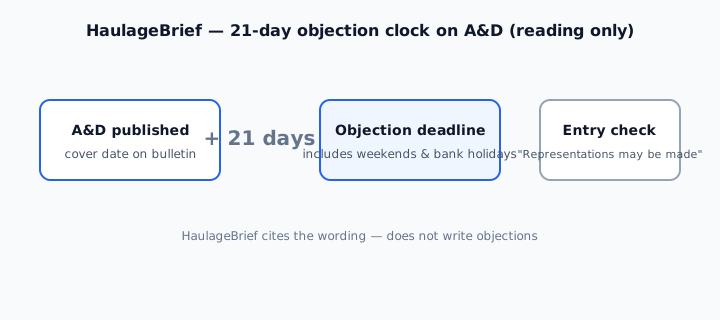
The 21-day period runs from the publication date printed on the cover of that week's A&D. For example, if the A&D issue is dated 6 September 2026, objections must be received by 27 September 2026. Saturdays, Sundays, and bank holidays count toward the 21 days under normal time-limit rules, but the OTC typically expects submissions by 23:59 on the final day.
Some online registers state "published on [date]" next to the entry — use that date if visible. If only the A&D issue date is clear, use that.
Which A&D entries have a 21-day window
Typical entries where objections are invited:
- New goods-vehicle operator-licence applications (standard national, standard international, or restricted).
- New PSV operator-licence applications (standard national, standard international, or restricted).
- Variations adding a new operating centre — the OTC may invite representations for a new centre even if the licence already exists.
- Variations increasing vehicle or trailer authorisation at an existing centre — the statute allows objection in some circumstances; check the A&D entry for "representations may be made".
Administrative changes (such as updating a transport manager without changing the operating centre) typically do not invite objections. If the A&D entry is silent on representations, HaulageBrief records "No objection invite printed on this entry".
What "Application received" means for the clock
An entry with status "Application received" is not yet a grant — it is the Traffic Commissioner publishing notice that the application has been accepted for consideration. The 21-day objection window opens on the publication date. See the sibling guide "Application received" is not a grant — reading A&D status words for more on status labels.
How to read the deadline from A&D
-
Find the A&D publication date — printed on the cover or header of the bulletin.
-
Add 21 days — that is the objection deadline. Count Saturdays, Sundays, and bank holidays.
-
Check the entry wording — does it state "Representations may be made"? If yes, the 21-day clock applies. If silent, note it.
-
Do not invent an invite — if the entry does not say representations are invited, do not assume the clock applies to that entry.
Worked example · published on GOV.UK
East of England A&D
See how HaulageBrief organises a weekly Applications & Decisions entry into a sourced £79 reading — not PI advocacy.
Public-interest context
The OTC objection guide (OGV2) explains who may object, what grounds are relevant, and the form to use. The Senior Traffic Commissioner's Statutory Guidance (section on operating centres) describes how representations are considered. Those are policy and guidance — not a reading of your specific A&D entry.
What HaulageBrief does with objection-clock wording
On the £79 sourced reading, we state the A&D publication date, calculate the 21-day deadline if representations are invited, and cite the entry wording. If the entry is silent, we say so. We do not advise whether to object, what grounds to use, or how to write the objection — that is advocacy, not reading.
See the East of England sample Order a £79 sourced reading
Questions
Does the 21-day clock include weekends?
Yes. The 21-day period runs from the A&D publication date and includes Saturdays, Sundays, and bank holidays under normal statutory time-limit rules. If the final day is a non-working day, check whether the OTC guidance allows submission on the next working day — HaulageBrief does not advise on that extension.
If I miss the 21-day window, can I still object?
HaulageBrief does not advise on late objections. Consult the OTC guidance or instruct a licensing adviser if you need to submit after the deadline.
Will HaulageBrief write the objection?
No. We read and organise the A&D entry into a sourced PDF. We do not write objections, representations, or advocacy submissions. Instruct a licensing consultant if you need objection drafting.
Is this licensing advice?
No. This guide and the £79 PDF are sourced readings of public A&D entries. The Traffic Commissioner's published entry and guidance remain the legal reference. If you need advice, instruct a licensing consultant or solicitor.
Who runs HaulageBrief?
Ellis Greensitt, sole trader, trading as HaulageBrief. English law. See terms and privacy. Email hello@haulagebrief.co.uk. No telephone.
Informational reading guide only. Sources: OTC — How to object (OGV2); Senior TC Statutory Guidance. Last reviewed 8 September 2026. HaulageBrief is not the Office of the Traffic Commissioner.