United Kingdom · guide · 21 September 2026
Goods vehicle vs PSV licence type wording on A&D — reading only
Traffic Commissioners publish separate weekly Applications & Decisions (A&D) bulletins for goods vehicles and for public service vehicles (PSV). Both use similar licence-type labels — Standard National, Standard International, and Restricted — but they appear in different GOV.UK collections and with different reference formats. This page explains how to read those labels on the page; it is not advice on which licence type to seek.
Two A&D families on GOV.UK
Goods-vehicle operator licensing and PSV operator licensing are separate regimes with separate weekly publications:
- Goods vehicle A&D — collected under Traffic Commissioner Goods Vehicle Applications and Decisions, by traffic area (east of England, London and the south east, and so on).
- PSV A&D — collected under Traffic Commissioner Public Service Vehicle Applications and Decisions, also by traffic area.
If you opened a goods-vehicle edition, you are reading goods entries — not PSV coach or bus applications. Check the collection title and cover wording before interpreting licence-type codes.
Goods-vehicle licence-type codes (SN, SI, R)
On many goods-vehicle A&D lines, the licence type appears as a two-letter code or spelled-out words next to the application or licence reference:
- SN — Standard National, as printed.
- SI — Standard International, as printed.
- R — Restricted, as printed (sometimes the word Restricted appears instead of a code).
Goods applications often use an OF reference (for example OF2093787). The code describes the kind of goods operator’s licence on that line — not whether it has been granted. See SN, SI, Restricted — reading licence-type codes on A&D.
PSV licence-type wording on A&D
PSV A&D entries use the same three licence-type labels in principle — Standard National, Standard International, and Restricted — but layout and abbreviations differ by traffic area:
- Some PSV editions spell the type in full (Standard National, Standard International, Restricted) rather than SN/SI/R codes.
- Some PSV editions use abbreviated forms; quote what that edition prints rather than assuming goods-vehicle house style.
- PSV application and licence references use PSV numbering (not OF numbers). The prefix and format vary by edition — cite the reference as printed.
- PSV entries refer to vehicles authorised for passenger use — not goods-vehicle and trailer authorisation figures. Read authorisation wording in context; do not transpose goods-vehicle field labels onto a PSV line.
HaulageBrief reads goods-vehicle A&D and public-inquiry written decisions for goods operators. We cite PSV wording accurately if you name a PSV A&D entry, but this guide’s SN/SI/R examples refer to goods-vehicle editions unless stated otherwise.
Shared reading discipline — code ≠ grant
Whether goods or PSV, the licence-type label tells you which kind of licence the line concerns as printed — not whether it has been granted:
- An SN line under new applications with status application received is still an application received.
- A Restricted PSV line under variations describes a change sought — not an automatic approval.
- Grants and refusals usually sit under decisions headings with outcome wording. See reading A&D status words.
How to spot goods vs PSV in four steps
-
Check the GOV.UK collection — goods vehicle or public service vehicle Applications and Decisions.
-
Read the cover and section headings — goods editions refer to goods-vehicle operator licensing; PSV editions refer to public service vehicles.
-
Note the reference format — OF numbers on goods lines; PSV licence or application references on PSV lines, as printed.
-
Cite the licence-type code or words exactly — SN/SI/R on goods editions; spelled-out or abbreviated PSV wording on PSV editions. Do not swap labels between regimes.
Worked example · published on GOV.UK
East of England A&D
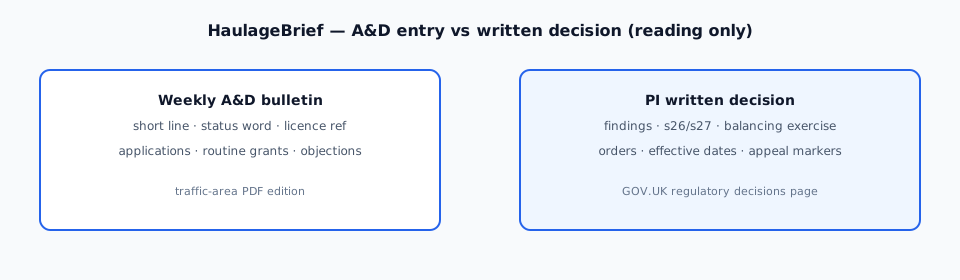
See how HaulageBrief organises a weekly goods-vehicle Applications & Decisions entry into a sourced £79 reading — not PI advocacy.
What this guide is not
- Not advice on whether you need a goods or PSV operator’s licence.
- Not advice on which licence type (Standard National, Standard International, or Restricted) to seek or hold.
- Not O-licence application writing for either regime.
- Not public-inquiry advocacy.
What HaulageBrief does with licence-type wording
On the £79 sourced reading, we state the licence-type code or spelled-out wording as printed, together with the section heading, status, operating centre(s), authorisation, transport manager if printed, and any objection deadline. We do not advise which type to apply for or invent codes the edition does not show.
See the East of England sample Order a £79 sourced reading
Questions
Do SN and SI codes appear on PSV A&D entries?
Sometimes, but PSV editions often spell Standard National, Standard International, or Restricted in full instead of using SN/SI/R codes. Layout varies by traffic area. Quote what your edition prints — do not assume goods-vehicle abbreviations apply to every PSV line.
Is an OF number a PSV licence reference?
No. OF references appear on goods-vehicle operator-licence lines. PSV entries use PSV application or licence references in the format that edition prints. Check the GOV.UK collection — goods vehicle or public service vehicle — before interpreting the reference.
Will HaulageBrief advise which licence type to apply for?
No. We cite the licence-type code or wording as printed. We do not advise whether to seek Standard National, Standard International, or Restricted in either regime.
Is this licensing advice?
No. This guide and the £79 PDF are sourced readings of public Traffic Commissioner publications. The Office of the Traffic Commissioner’s document remains the legal record. If you need advice, instruct a transport consultant or solicitor.
Who runs HaulageBrief?
Ellis Greensitt, sole trader, trading as HaulageBrief. English law. See terms and privacy. Email hello@haulagebrief.co.uk. No telephone.
Informational reading guide only. Sources: GOV.UK — Traffic Commissioner Goods Vehicle Applications and Decisions; GOV.UK — Traffic Commissioner Public Service Vehicle Applications and Decisions. Last reviewed 21 September 2026. HaulageBrief is not the Office of the Traffic Commissioner.