United Kingdom · Traffic Commissioner papers · reading only
What “interim” language usually signals on published papers
How to read interim, interim licence, and interim direction wording when it appears on a Traffic Commissioner Applications & Decisions entry or related published paper — and why interim is not the same as a final grant. Not licensing advice; not how to request interim; not public-inquiry advocacy.
Status words such as “application received” are covered separately in reading A&D status words. This page is narrower: what the word interim usually signals when it appears on the published paper itself. For the fuller field map (licence type, operating centre, authorisation, transport manager, objection clock), see how to read an A&D entry.
Interim is a temporary label, not a final outcome
Under the Goods Vehicles (Licensing of Operators) Act 1995, Traffic Commissioners may issue an interim licence on a new operator’s-licence application, or give an interim direction while a variation application is still open. In plain reading terms:
- Interim licence — usually marks a temporary operator’s licence issued while the full application remains to be determined.
- Interim direction — usually marks a temporary variation of an existing licence (for example authorisation or operating-centre change) that continues until the variation application is finally disposed of, or until another end date the paper states.
- Neither label, by itself, means the Commissioner has finally granted the full application or variation in the terms sought for the long term.
Statute and statutory guidance set the legal mechanics. HaulageBrief’s job stops at quoting what the published edition or decision page actually says.
Where interim wording usually sits on A&D
Weekly Applications & Decisions editions are collected on GOV.UK under Traffic Commissioner Goods Vehicle Applications and Decisions. House style varies by traffic area, but interim language commonly appears:
- under a decisions or similar heading, describing that an interim licence or interim direction has been given;
- beside an operator line that still sits in a live applications context — so you must read the section heading before upgrading the meaning;
- with wording that may name the authorisation, centre, or other terms of the interim grant as printed — still quote those terms; do not invent ones the PDF omits.
If the same edition also lists the underlying application as received, that does not cancel the interim label — and the interim label does not upgrade the full application into a final grant. Treat each printed status phrase on its own line.
A short reading checklist for “interim”
-
Open the named publication on GOV.UK and find the operator entry or decision line.
-
Read the section heading first — applications, variations, decisions, or inquiry-related.
-
Quote the interim phrase as printed — “interim licence”, “interim direction”, or other interim wording — without swapping labels.
-
Do not treat interim as final unless the same paper (or a later published decision) records a final grant, refusal, or other disposal in those terms.
-
Stay in the reading lane — no interim-request drafting, no objection drafting, no PI advocacy from this page.
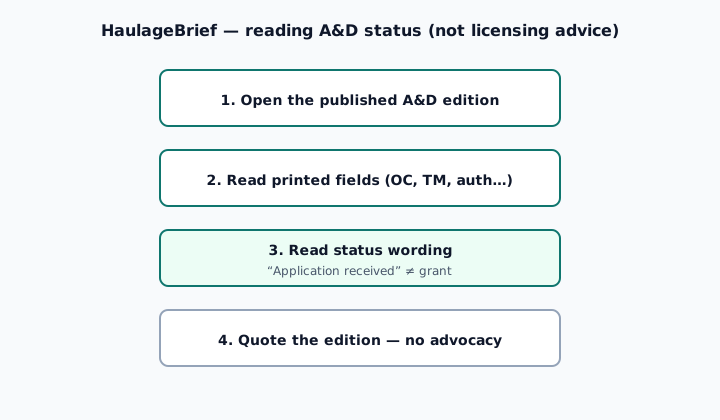
Worked contrast · one live sample (not interim)
East of England AD 5603 — GBRS HAULAGE LIMITED, OF2093787
That sample records status as application received — not an interim grant and not a final grant. Use it as a reminder that sought authorisation and a named transport manager on an applications line are still not a completed outcome. When an edition does print interim wording, apply the same discipline: quote the label, read the heading, do not upgrade it.
Interim vs other status words (and written decisions)
Keep three reading lanes separate:
- Application / variation received — publication of a request; not a grant. See A&D status words.
- Interim licence / interim direction — temporary grant pending final disposal (as the paper states).
- Final decisions / PI written decisions — outcomes and orders as published; see how to read a Traffic Commissioner written decision. Appeal or stay markers on the regulatory-decisions listing are a further status layer — quote them when present; do not treat them as interim by default.
Stay in the reading lane
- Do not treat this page as “how to get interim” guidance.
- Do not treat it as how to object, vary, or surrender.
- Do not treat it as public-inquiry advocacy or O-licence drafting help.
- Do not upgrade interim into a final grant — or downgrade a final grant into interim — without the wording on the page.
What a £79 HaulageBrief PDF is (and is not)
You paste the public GOV.UK URL of a named A&D edition (or a named public-inquiry written decision) and name the operator if the PDF lists several. We send a PDF in 24 hours that states the operator, licence or application number, and licence type; lists operating centre(s) and authorisation as published; names the transport manager if printed; states the status of the item — including interim wording when the paper prints it; cites the published wording; and records the objection deadline if that edition still prints one. If the publication is thin, the PDF says so. If we cannot read a public document, we refund. We do not invent centres, vehicles, or outcomes.
What it is not
- Not licensing advice. We do not tell you whether to apply, request interim, object, or how to run the fleet.
- Not O-licence application writing. We do not prepare, lodge, or chase an application, variation, interim request, or newspaper notice.
- Not public-inquiry advocacy. We do not represent anyone before a Traffic Commissioner.
- Not TM CPC training, and not a substitute for reading the publication or instructing a transport consultant or solicitor.
See the East of England sample Order a £79 sourced reading
Questions
Does “interim” mean the full licence or variation is finally granted?
Usually no. Interim wording typically marks a temporary grant that continues until the full application or variation is finally disposed of, or until another published end-date applies. Always read the section heading and quote the exact wording on the page in front of you. HaulageBrief states that status; it does not upgrade interim into a final grant.
Is an interim direction the same as an interim licence?
Related, not identical. An interim licence is typically tied to a new operator’s-licence application; an interim direction typically varies an existing licence while a variation remains open. Quote whichever phrase the paper prints.
Is this licensing advice or how to apply for interim?
No. This guide and the £79 PDF are sourced readings of public Traffic Commissioner publications. The Office of the Traffic Commissioner’s document remains the legal record. If you need advice, instruct a transport consultant or solicitor.
Will you tell me how to object or represent us at a public inquiry?
No. We do not prepare, lodge, or chase objections, and we do not advocate, appear, or prepare a case. A written-decision brief is a reading of what was published, not representation. See the GOV.UK objections guide for official process information.
Who runs HaulageBrief?
Ellis Greensitt, sole trader, trading as HaulageBrief. English law. See terms and privacy. Email hello@haulagebrief.co.uk. No telephone.
Informational reading guide only. Sources: GOV.UK — Traffic Commissioner Goods Vehicle Applications and Decisions; Goods Vehicles (Licensing of Operators) Act 1995 (interim licences and interim variations); HaulageBrief sample for East of England AD 5603, GBRS HAULAGE LIMITED OF2093787 (contrast — application received, not interim). Public sector information reused under the Open Government Licence v3.0. Last reviewed Sep 2026. HaulageBrief is not the Office of the Traffic Commissioner and is not GOV.UK.