United Kingdom · guide · 10 September 2026
A&D weekly edition vs public-inquiry written decision — which document
Traffic Commissioner publications on GOV.UK fall into two families most haulage readers confuse: the weekly Applications & Decisions (A&D) bulletin, and standalone public-inquiry written decisions after a hearing. They look similar in a search result. They are not the same document type — and the 21-day objection clock may apply to one but not the other.
Worked example · published on GOV.UK
East of England A&D
See how HaulageBrief organises a weekly Applications & Decisions entry into a sourced £79 reading — not PI advocacy.
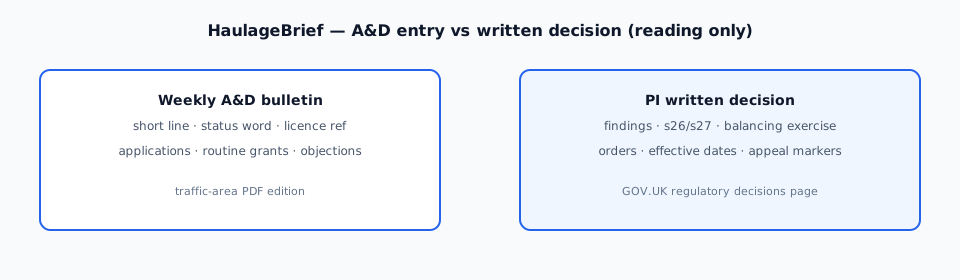
Family one: the weekly A&D edition
An A&D edition is the whole PDF for one traffic area and week (for example East of England number 5603). Inside it, each operator line is an A&D entry. These editions publish:
- New goods-vehicle operator-licence applications and variations.
- Status wording such as “application received” or “granted” under section headings.
- Sometimes a statutory objection deadline in the edition header for applications advertised that week.
For the field map — licence type, operating centre, authorisation, transport manager, status — see how to read an A&D entry. For the 21-day clock, see A&D 21-day objection clock.
Family two: the public-inquiry written decision
After a public inquiry (or written representations route that produces a formal decision), the Traffic Commissioner publishes a written decision as its own document. Typical contents:
- Parties and representation.
- Findings of fact and balancing exercise.
- An order (grant, refusal, curtailment, revocation, conditions).
These are not “application received” lines in a weekly bulletin. For structure, see how to read a public-inquiry written decision.
Why the distinction matters
- Objection clocks. The 21-day statutory objection window applies to many new applications published in A&D — not to a final written decision after inquiry.
- Status words. “Application received” on A&D is not a grant. A written decision after inquiry states an outcome — different grammar, different stakes. See A&D status words.
- What you quote. HaulageBrief reads one named entry or one named written decision. Pasting the wrong URL type produces the wrong reading.
How to tell from a GOV.UK page (literacy only)
-
Check the collection. A&D editions live under Traffic Commissioner Applications and Decisions by traffic area. Written decisions are usually separate publications linked from inquiry outcomes.
-
Read the title. “Applications and Decisions — East of England — No. 5603” is an edition. “Written decision — [Operator] — [reference]” is a decision document.
-
Skim the first page. A&D lists many operators under section headings. A written decision opens with parties and background to a single case.
-
Name the operator. If several operators appear in one A&D PDF, tell us which line you mean when you order a £79 reading.
Common misreads
- Treating a post-inquiry written decision as if it were still in “application received” status on A&D.
- Assuming a 21-day header date on an A&D edition applies to every decision listed later in the same PDF.
- Quoting interim A&D wording as a final outcome — see interim language on published papers.
What HaulageBrief does
You paste the public GOV.UK URL of a named A&D edition (and name the operator if several appear) or a named public-inquiry written decision. We send a £79 PDF in 24 hours that states the operator, licence or application number, licence type, operating centre(s), authorisation, transport manager if printed, status or outcome wording as published, and the objection deadline if that edition still prints one for that entry. If the publication is thin, the PDF says so. We do not invent centres, vehicles, or outcomes — and we do not advise whether to object or appear at inquiry.
See the East of England sample Order a £79 sourced reading
Questions
Is an A&D entry the same as a written decision?
No. A&D is a weekly bulletin of applications, variations, and related notices. A public-inquiry written decision is a standalone outcome document with findings and an order. HaulageBrief reads whichever type you name.
Does the 21-day objection clock apply to written decisions?
Usually not in the same way as new applications advertised in A&D. The weekly edition header date belongs to applications published in that issue. A final written decision after inquiry states an outcome — see the 21-day clock guide for how we read deadlines on A&D only.
Will HaulageBrief object or represent me at inquiry?
No. We do not prepare, lodge, or chase objections, and we do not advocate or appear at public inquiry. We read one named published entry or written decision.
Is this licensing advice?
No. This guide and the £79 PDF are sourced readings of public documents. Instruct a transport consultant or solicitor if you need advice.
Informational reading guide only. Sources: GOV.UK — Traffic Commissioner Applications and Decisions. Last reviewed 10 September 2026. HaulageBrief is not the Office of the Traffic Commissioner.