United Kingdom · Traffic Commissioner A&D · reading only
Goods in transit insurance wording on A&D application lines
How goods in transit (GIT) insurance references appear on published Traffic Commissioner Applications & Decisions application and variation lines — and how they differ from insurance findings on public-inquiry written decisions. Literacy only; not insurance advice; not licensing advice; not O-licence drafting; not public-inquiry advocacy.
Goods in transit (GIT) insurance is a mandatory continuous requirement under section 27 of the Goods Vehicle (Licensing of Operators) Act 1995 for operators holding Standard National or Standard International licences. On published Traffic Commissioner papers, GIT references appear with different levels of detail depending on document type — a short note on an A&D application line is not the same as a findings paragraph after public inquiry. This page helps you read what the publication prints about GIT cover without upgrading placeholders into conclusions, and without treating this as insurance advice. For the full A&D field map, see how to read an A&D entry.
Where GIT wording appears — two document families
Name the document before you quote a line about goods in transit insurance. See A&D weekly edition vs public-inquiry written decision.
- Weekly A&D application or variation line. May print little or nothing about GIT. Some editions note that cover is to be provided, that a certificate is awaited, or that a policy number or insurer name accompanies the application. The status line still describes receipt or a sought change — not a passed insurance test. See reading A&D status words.
- Public-inquiry written decision. May record whether adequate GIT insurance was demonstrated under section 27(1)(c), with narrative about policy limits, gaps in cover, or failure to maintain insurance. The operative order may follow from those findings. See how to read a written decision.
HaulageBrief cites GIT insurance wording as printed. We do not review your policy schedule or advise whether cover meets statutory or Traffic Commissioner expectations.
Literacy: named cover vs “to be provided”
Published papers use several patterns for GIT on application lines. Quote exactly what the edition shows:
- Silent on GIT — many A&D application lines say nothing about goods in transit insurance. That silence is a literacy cue: the edition does not record an insurance conclusion on that line. HaulageBrief records the silence; we do not infer adequate cover from licence type alone.
- “To be provided” / “awaited” / similar — placeholder wording that a certificate or policy evidence is outstanding or expected. Cite it as printed. Do not upgrade it into “GIT insurance demonstrated” or “adequate cover confirmed”.
- Named insurer or policy reference — some entries reference an insurer, broker, or policy number. Quote the reference as printed; do not treat a cited policy number as proof the Traffic Commissioner has accepted the cover unless the status or decision section says so.
- Cover level or sum insured cited — occasional lines print a figure (for example £50,000 per vehicle). Quote the figure as published; do not treat it as advice on whether that level is adequate for your operation.
- Adverse findings after inquiry — written decisions may record that adequate GIT insurance is not demonstrated, that cover lapsed, or that the mandatory requirement under section 27 is not met. Quote the findings and any order (refusal, revocation, conditions) as published.
Unknown stays unknown. If the A&D line does not state whether GIT evidence was accepted, HaulageBrief does not fill the gap from industry assumption or from a separate GOV.UK page you did not send.
GIT on new applications vs variations vs Restricted licences
GIT is a Standard licence requirement. On A&D:
- Standard National (SN) or Standard International (SI) new applications may print GIT notes alongside other section 27 requirements. Read them with the section heading — new application vs variation. See variation vs new application and SN, SI, Restricted codes.
- Variations — for example a vehicle increase or licence-type upgrade from Restricted to Standard — may note GIT cover where the publication records it. A GIT note on a variation line does not by itself mean the variation is granted.
- Restricted (R) licences — GIT is not a mandatory requirement for Restricted licences in the same way. If a Restricted application line is silent on GIT, that aligns with licence type; silence is not automatically a problem on R lines. HaulageBrief records what prints; we do not advise on licence-type choice.
GIT is not the status line — read both
Operators sometimes see an insurance note on an application and assume the licence is granted. It is not. Always read the section heading and status wording together:
- “Application received” with a GIT “to be provided” note is still application received.
- A variation seeking more vehicles with an insurer name cited is still a sought change until the decisions section records an outcome.
- Adverse GIT findings appear in written decisions or disciplinary sections — not as a substitute for reading curtailment or revocation status lines. See curtailment, revocation and suspension on A&D.
GIT sits alongside financial standing and good repute as section 27 mandatory requirements on Standard licences. For FS and repute patterns on application lines, see financial standing and repute wording. HaulageBrief does not merge those fields into a single “passed section 27” conclusion unless the publication does.
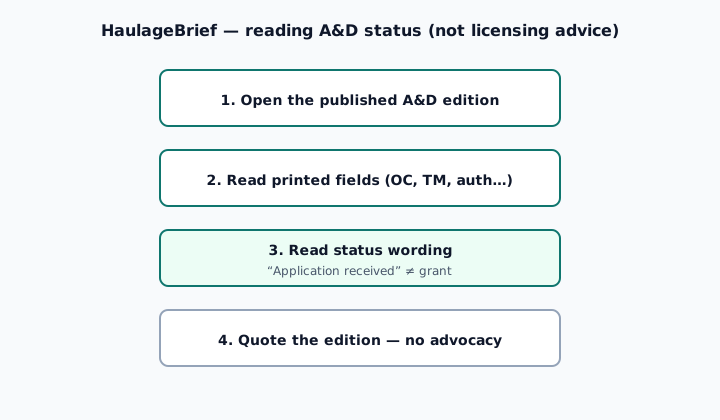
Worked example · one live sample
East of England AD 5603 — GBRS HAULAGE LIMITED, OF2093787
SN application. Operating centre at Sunderland Hill, Ravensden. Authorisation sought: 16 vehicles and 20 trailers. Transport manager named as Stephen Page. The edition prints no goods in transit insurance line on that application — silence, not proof of cover and not proof of inadequate cover. Status: application received — not recorded as granted or refused.
Stay in the reading lane
- Do not treat this page as advice on GIT cover levels, insurers, or policy wording.
- Do not treat it as licensing advice on meeting section 27 insurance requirements.
- Do not treat it as public-inquiry advocacy or objection drafting.
- Do not treat it as O-licence application writing or insurance certificate annex drafting.
- Do not treat “to be provided” or a silent GIT field as proof of grant or adequate cover.
What a £79 HaulageBrief PDF is (and is not)
£79 one-off · one named UK A&D entry OR one named public-inquiry written decision · PDF in 24 hours. Reading / extract-and-organise only.
You paste the public GOV.UK URL of a named A&D edition (or a named public-inquiry written decision) and name the operator if the PDF lists several. We send a PDF in 24 hours that states the operator, licence or application number, and licence type; lists operating centre(s) and authorisation as published; names the transport manager if printed; records any goods in transit insurance wording as published (or states that the edition is silent); states the status of the item; cites the published wording; and records the objection deadline if that edition still prints one. On written decisions we cite section 27 insurance findings and orders as printed. If the publication is thin, the PDF says so. If we cannot read a public document, we refund. We do not invent insurance conclusions or outcomes.
What it is not
- Not insurance advice. We do not tell you what cover to buy, which broker to use, or whether a policy meets your needs.
- Not licensing advice. We do not tell you whether you meet section 27 requirements or how to run the fleet.
- Not O-licence application writing. We do not prepare, lodge, or chase an application, variation, or insurance annex.
- Not public-inquiry advocacy. We do not represent anyone before a Traffic Commissioner.
- Not a substitute for reading the publication, reviewing your policy with a broker, or instructing a transport consultant or solicitor.
See the East of England sample Order a £79 sourced reading
Questions
Does GIT insurance wording on an A&D application line mean cover is accepted?
No. A note that GIT cover is to be provided, or a policy reference printed on an application line, describes what the publication records for that item — not a Traffic Commissioner finding that adequate insurance is in place. Always read the section heading and status wording. See reading A&D status words.
What if the A&D line says nothing about GIT insurance?
Silence is a literacy cue: the edition does not record an insurance conclusion on that line. HaulageBrief records the silence. We do not infer adequate or inadequate cover from licence type or authorisation figures alone.
What does “GIT cover to be provided” mean?
It is placeholder wording as printed — evidence outstanding or expected, not a Traffic Commissioner finding that adequate goods in transit insurance is demonstrated. Cite it exactly as the edition shows.
Will you advise on GIT insurance levels or brokers?
No. We cite GIT insurance wording as printed on the document you send. We do not review policies, recommend insurers, or advise on cover levels.
Is this insurance or licensing advice?
No. This guide and the £79 PDF are sourced readings of public Traffic Commissioner publications. The Office of the Traffic Commissioner’s document remains the legal record. If you need advice, instruct an insurance broker, transport consultant, or solicitor.
Who runs HaulageBrief?
Ellis Greensitt, sole trader, trading as HaulageBrief. English law. See terms and privacy. Email hello@haulagebrief.co.uk. No telephone.
Informational reading guide only. Sources: GOV.UK — Traffic Commissioner Goods Vehicle Applications and Decisions; GOV.UK — Traffic Commissioner regulatory decisions; HaulageBrief sample for East of England AD 5603, GBRS HAULAGE LIMITED OF2093787. Public sector information reused under the Open Government Licence v3.0. Last reviewed 22 September 2026. HaulageBrief is not the Office of the Traffic Commissioner and is not GOV.UK.