United Kingdom · guide · 21 September 2026
New operator-licence application vs variation on A&D — reading only
Applications & Decisions (A&D) publishes both first-time operator-licence applications and variations to existing licences in the same weekly bulletin. The section heading and status wording tell you which type you are reading — not the licence-type code alone. This page is a plain reading guide for spotting the difference on A&D; it is not advice on whether to apply, vary, or object.
Why the distinction matters on A&D
A new application line describes someone seeking an operator’s licence for the first time (or re-applying after surrender or revocation, as the edition states). A variation line describes a change to a licence that already exists — for example adding an operating centre, increasing authorisation, or changing the transport manager.
Both may appear in the same weekly PDF, but under different section headings with different status vocabulary. Misreading a variation as a new application (or vice versa) leads to wrong assumptions about whether a licence already exists and whether a 21-day objection clock applies. See the 21-day objection clock guide for how we read deadlines on A&D only.
Read the section heading first
Layout varies by traffic area, but the section heading is the primary cue:
- New applications / applications received → a first-time application is published, not a grant.
- Variations / variations sought → a change to an existing licence is published, not an automatic approval of that change.
- Decisions sections → grants, refusals, and other outcomes as the Traffic Commissioner published them.
HaulageBrief states the section heading in plain English before summarising the entry. We do not upgrade an application into a grant or a variation into a completed change unless the edition says so. See reading A&D status words.
Wording cues on a new application line
Typical patterns on a new application entry (illustrative — quote what your edition prints):
- Section under new applications or similar.
- Status: application received — not “variation sought” or “licence granted”.
- Application reference (for goods vehicles, often an OF number) without a pre-existing licence number cited as already held — unless the edition explicitly states otherwise.
- Operating centre and authorisation described as sought — vehicle and trailer numbers are what the applicant asks for, not necessarily what is already authorised.
- Transport manager named or “to be appointed” on an applications line — still an application, not a grant. See transport manager wording on A&D.
- Objection invite: many new applications state that representations may be made within 21 days of publication.
Wording cues on a variation line
Typical patterns on a variation entry (illustrative — quote what your edition prints):
- Section under variations or similar — not under new applications.
- Status: variation sought, application to vary, or wording the edition uses for a requested change — not “application received” for a new licence.
- Existing licence number cited — the operator already holds a licence and seeks to change it.
- Change described explicitly: new operating centre, increased authorisation at a named centre, transport-manager change, or other variation type as printed.
- Objection invite: some variations (especially new operating centres) may invite representations; others may not. Check the entry — do not assume the 21-day clock applies to every variation.
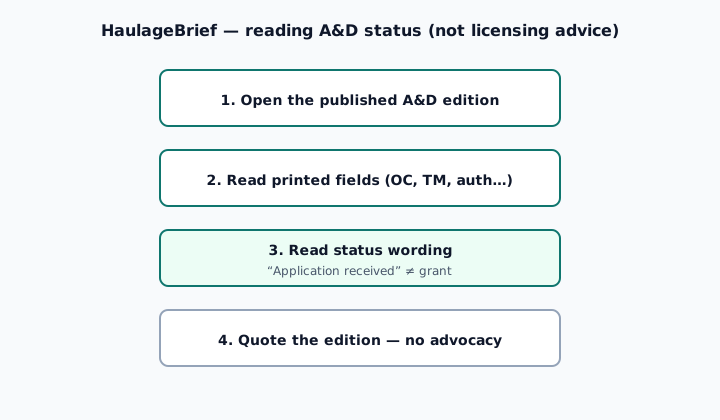
How to tell them apart in four steps
-
Find the section heading — new applications, variations, or decisions. That heading sets the meaning of every line beneath it.
-
Read the status line — “application received” on a new applications line is not the same as “variation sought” on a variations line.
-
Check for an existing licence number — variations usually cite a licence already held; new applications usually cite an application reference.
-
Quote authorisation and centre wording as printed — sought figures on an application line are not the same as a recorded increase on a variation line unless the status and section say so. See authorisation vs operating centre on A&D.
Worked example · published on GOV.UK
East of England A&D
See how HaulageBrief organises a weekly Applications & Decisions entry into a sourced £79 reading — not PI advocacy.
What this guide is not
- Not advice on whether to apply for a new licence or lodge a variation.
- Not O-licence application writing or variation drafting.
- Not public-inquiry advocacy or objection drafting.
- Not a substitute for the GOV.UK A&D collection or instructing a transport consultant or solicitor.
What HaulageBrief does with application vs variation wording
On the £79 sourced reading, we state the section heading, whether the entry is a new application or a variation as printed, the status wording, licence or application reference, operating centre(s), authorisation, transport manager if printed, and any objection deadline the edition states. If the publication is thin, the PDF says so. We do not invent outcomes or advise whether to apply or vary.
See the East of England sample Order a £79 sourced reading
Questions
Does “application received” mean it is a new licence application?
Usually yes — when that status appears under a new applications section heading. The same status vocabulary does not appear on variation lines, which typically use “variation sought” or similar. Always read the section heading first. See reading A&D status words.
Can a variation invite objections like a new application?
Some variations — especially those adding a new operating centre — may invite representations within 21 days. Others may not. Check the entry wording; do not assume every variation triggers the same clock as a new application. See the 21-day objection clock guide.
Will HaulageBrief write a new application or variation?
No. We read and organise a named published A&D entry or written decision into a sourced PDF. We do not prepare, lodge, or chase applications or variations.
Is this licensing advice?
No. This guide and the £79 PDF are sourced readings of public A&D entries. The Traffic Commissioner’s published entry and guidance remain the legal reference. If you need advice, instruct a licensing consultant or solicitor.
Who runs HaulageBrief?
Ellis Greensitt, sole trader, trading as HaulageBrief. English law. See terms and privacy. Email hello@haulagebrief.co.uk. No telephone.
Informational reading guide only. Sources: GOV.UK — Traffic Commissioner Goods Vehicle Applications and Decisions; Senior TC Statutory Guidance. Last reviewed 21 September 2026. HaulageBrief is not the Office of the Traffic Commissioner.