United Kingdom · Traffic Commissioner A&D · reading only
Voluntary surrender vs revocation wording on A&D and written decisions
How to read voluntary surrender and revocation vocabulary on published Traffic Commissioner Applications & Decisions entries and on public-inquiry written decisions. Literacy only; not licensing advice; not surrender drafting; not objection advocacy; not O-licence application writing.
When an operator-licence ends, the published record may say voluntary surrender, surrender accepted, revoked, or related terms — and those words are not interchangeable on the page in front of you. Voluntary surrender describes an operator-initiated step recorded by the Traffic Commissioner; revocation describes a regulatory order imposed after inquiry, disciplinary action, or a statutory process. This guide helps you read what the publication prints without collapsing different vocabulary into one outcome. For the wider disciplinary vocabulary map, see curtailment, revocation and suspension on A&D.
Two document families — name the paper first
Surrender and revocation lines appear in different publication types with different levels of detail. See A&D weekly edition vs public-inquiry written decision.
- Weekly A&D edition. A traffic-area bulletin under section headings such as decisions, surrenders, or disciplinary action. Surrender and revocation may appear as short status lines — sometimes one sentence with a licence number and effective date.
- Public-inquiry written decision. A standalone GOV.UK publication with parties, findings under sections 26 and 27 of the Goods Vehicle (Licensing of Operators) Act 1995, a balancing exercise, and an operative order. Revocation after inquiry is usually spelled out in full — including immediate or deferred effective dates, disqualification, and rehabilitation wording where applicable.
HaulageBrief cites surrender and revocation wording as printed on whichever public URL you send. We do not infer voluntary surrender from a revocation order, or vice versa.
Voluntary surrender — common A&D patterns
On published A&D papers, voluntary surrender vocabulary typically signals that the operator sought to give up the licence and the Traffic Commissioner recorded acceptance. Common patterns include:
- “Voluntary surrender” / “surrender of licence” — the status line names surrender as the action. Quote it exactly; do not relabel it as revocation.
- “Surrender accepted” / “surrender to take effect” — acceptance wording with or without a stated effective date. If a date is printed, cite it; if not, do not invent one from licence expiry assumptions.
- Partial surrender — some editions record surrender of part of an authorisation or removal of an operating centre while the licence continues in reduced form. That is not the same as full licence revocation unless the status line says so.
- Surrender alongside other entries — the same operator may appear on a variation line in one edition and a surrender line in a later edition. Read each line in its section context; do not merge editions.
Unknown stays unknown. If the A&D line does not state whether surrender was operator-initiated or whether any conditions attach, HaulageBrief records what is printed and does not fill gaps from industry assumption.
Revocation — how it differs on the page
Revocation vocabulary records a regulatory order ending the licence — usually after inquiry, a disciplinary process, or a statutory trigger described on the published paper. Patterns include:
- “Revoked” / “revocation order” — immediate or deferred. Look for an effective date or “with immediate effect” wording as printed.
- Revocation after inquiry — the A&D edition may carry a one-line notice pointing to a fuller written decision with findings and the operative order.
- Revocation with disqualification — director or transport-manager disqualification may appear on the same line or in the written decision. See transport manager wording on A&D.
- Deferred revocation — the order may state a future date or a condition after which revocation takes effect. Cite the deferral wording; do not shorten it to “revoked now” unless the paper says so.
This guide does not advise how to avoid revocation, how to appeal, or whether surrender is preferable to waiting for a disciplinary outcome. Those are operational or legal questions for the published record and, if you need help, for a transport consultant or solicitor.
Surrender vs revocation — literacy cues on A&D
Operators sometimes misread because both outcomes end the licence. On published papers, keep these cues separate:
- Section heading — surrenders may sit under “Surrenders” or “Decisions”; revocations under “Disciplinary action”, “Decisions”, or inquiry-related headings. The heading is part of the citation.
- Status vocabulary — “voluntary surrender” is not “revoked”. “Revocation order” is not “surrender accepted”. Quote the words the PDF shows.
- Application lines are different — “application received” on a new applications page is not surrender or revocation. See reading A&D status words.
- Interim wording — interim suspension or direction is not a final surrender or revocation. See what “interim” language signals.
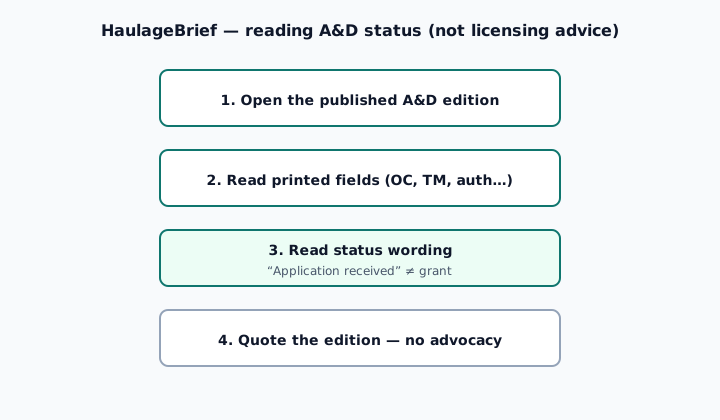
Worked example · one live sample
East of England AD 5603 — GBRS HAULAGE LIMITED, OF2093787
This edition shows a new application line — status application received — not surrender or revocation vocabulary. When you search GOV.UK for surrender or revocation entries, confirm you are on the correct section and edition before quoting a status line. HaulageBrief reads the named URL you send; a new-application PDF will not contain surrender or revocation wording unless that operator also appears under a different heading in the same issue.
Written decisions — surrender and revocation in full
After public inquiry, a written decision may record that the operator offered surrender, that surrender was accepted as an alternative to revocation, or that revocation was ordered despite surrender being offered. The operative order paragraph is the citation anchor — not a summary line from an A&D index.
Findings under section 27 (good repute, financial standing, professional competence) may precede the order. HaulageBrief cites findings and orders as printed; we do not re-argue whether surrender should have been accepted or revocation was proportionate.
The 21-day objection clock usually does not apply here
Many A&D editions print a statutory objection deadline in the header for new applications advertised that week. That clock belongs to those application lines — not to surrender or revocation entries listed elsewhere in the same PDF. See A&D 21-day objection clock. This guide does not tell you whether you may object to a surrender notice or how to draft a representation.
Stay in the reading lane
- Do not treat this page as advice on whether to surrender an O-licence or how to lodge a surrender with the Traffic Commissioner.
- Do not treat it as revocation appeal guidance or disciplinary-response drafting.
- Do not treat it as public-inquiry advocacy or objection drafting.
- Do not treat “voluntary surrender” and “revoked” as interchangeable when quoting an A&D line.
- Do not treat a one-line A&D surrender or revocation notice as containing the full findings when a separate written decision exists on GOV.UK.
What a £79 HaulageBrief PDF is (and is not)
£79 one-off · one named UK A&D entry OR one named public-inquiry written decision · PDF in 24 hours. Reading / extract-and-organise only.
You paste the public GOV.UK URL of a named A&D edition (or a named public-inquiry written decision) and name the operator if the PDF lists several. We send a PDF in 24 hours that states the operator, licence or application number, and licence type; lists operating centre(s) and authorisation as published; names the transport manager if printed; records surrender or revocation wording as published (including effective dates where printed); states the status of the item; cites the published wording; and records the objection deadline if that edition still prints one on application lines. On written decisions we cite findings and orders as printed. If the publication is thin, the PDF says so. If we cannot read a public document, we refund. We do not invent surrender reasons, revocation findings, or outcomes.
What it is not
- Not licensing advice. We do not tell you whether to surrender, how to respond to revocation, or how to run the fleet after licence loss.
- Not O-licence application writing. We do not prepare, lodge, or chase a surrender, variation, or fresh application.
- Not public-inquiry advocacy. We do not represent anyone before a Traffic Commissioner.
- Not surrender drafting, not revocation appeal work, and not a substitute for reading the publication or instructing a transport consultant or solicitor.
See the East of England sample Order a £79 sourced reading
Questions
Is voluntary surrender the same as revocation on A&D?
No. Published Traffic Commissioner papers use different vocabulary. Voluntary surrender records that the operator sought to give up the licence; revocation records a regulatory order ending the licence. Quote the status line as printed — do not treat them as interchangeable. See curtailment, revocation and suspension.
Where do I find surrender vs revocation on GOV.UK?
Search the Traffic Commissioner Applications & Decisions collection for weekly editions, and the regulatory decisions collection for public-inquiry written decisions. Name the document type before you quote a status line. See A&D vs written decision.
Can a written decision mention both surrender and revocation?
Yes. A written decision may record that surrender was offered, accepted, or refused, and may order revocation if surrender was not accepted or conditions were not met. Cite the operative order paragraph as printed.
Will you advise whether to surrender an O-licence?
No. We cite surrender and revocation wording as printed on the document you send. We do not advise whether to surrender, how to lodge a surrender, or how to respond to a revocation order.
Is this licensing advice?
No. This guide and the £79 PDF are sourced readings of public Traffic Commissioner publications. The Office of the Traffic Commissioner’s document remains the legal record. If you need advice, instruct a transport consultant or solicitor.
Who runs HaulageBrief?
Ellis Greensitt, sole trader, trading as HaulageBrief. English law. See terms and privacy. Email hello@haulagebrief.co.uk. No telephone.
Informational reading guide only. Sources: GOV.UK — Traffic Commissioner Goods Vehicle Applications and Decisions; GOV.UK — Traffic Commissioner regulatory decisions; HaulageBrief sample for East of England AD 5603, GBRS HAULAGE LIMITED OF2093787. Public sector information reused under the Open Government Licence v3.0. Last reviewed 23 September 2026. HaulageBrief is not the Office of the Traffic Commissioner and is not GOV.UK.