United Kingdom · guide · 16 September 2026
What is a goods vehicle operator’s licence (O-licence)? — reading only
A goods vehicle operator’s licence — often called an O-licence — is the licence a Traffic Commissioner issues that authorises an operator to run goods vehicles above a certain weight for trade or hire or reward in Great Britain. This guide explains what the licence is, what gets published about it, and how to read a published entry. It does not tell you whether you need a licence, how to apply, or how to run a compliant fleet.
What an O-licence authorises (as described on GOV.UK)
Under the goods-vehicle operator-licensing regime in Great Britain, operators who use vehicles above specified weight limits for carrying goods in connection with a trade or business, or for hire or reward, generally need an operator’s licence issued by the Traffic Commissioner for their traffic area. The licence sets out:
- Licence type — Standard National (SN), Standard International (SI), or Restricted (R), as described on published materials. See SN, SI, Restricted codes on A&D.
- Operating centre(s) — the address(es) where vehicles are normally kept. See authorisation vs operating centre on A&D.
- Authorisation — the number of vehicles and trailers the licence covers. On an application entry, these figures are what is sought unless the edition records a grant.
- Transport manager — on standard licences, a named transport manager is usually part of the licence record as published. See transport manager wording on A&D.
This guide describes how those elements appear on public documents. For legal thresholds (vehicle weights, exemptions, licence types), see GOV.UK — Being a goods vehicle operator and instruct a transport consultant or solicitor if you need advice on your operation.
Who issues and oversees O-licences
Traffic Commissioners for Great Britain issue and oversee goods vehicle operator’s licences. There are separate traffic areas (east of England, London and the south east, north east, north west, West Midlands, west of England, Scotland, and Wales). Applications are processed by the Office of the Traffic Commissioner; decisions are made by the Traffic Commissioner for that area.
HaulageBrief is not the Office of the Traffic Commissioner and is not GOV.UK. We read what they publish — we do not issue, vary, or enforce licences.
Where licence activity is published
Traffic Commissioners publish a weekly statement called Applications and Decisions (A&D) for each traffic area. It lists:
- New operator-licence applications received.
- Variations to existing licences (extra vehicles, new operating centres, changes of transport manager).
- Decisions — grants, refusals, surrenders, and other outcomes as published.
- Disciplinary actions — curtailments, suspensions, revocations (see curtailment, revocation and suspension wording).
- Public-inquiry listings and, separately, written inquiry decisions.
Editions are collected on GOV.UK under Traffic Commissioner Goods Vehicle Applications and Decisions. An A&D edition is the whole PDF for that week and area. An A&D entry is one named operator line inside it — the unit HaulageBrief reads when you paste a URL and name the operator.
For the difference between a weekly A&D entry and a standalone public-inquiry written decision, see A&D edition vs written decision — which document.
Reading an O-licence entry — the basics
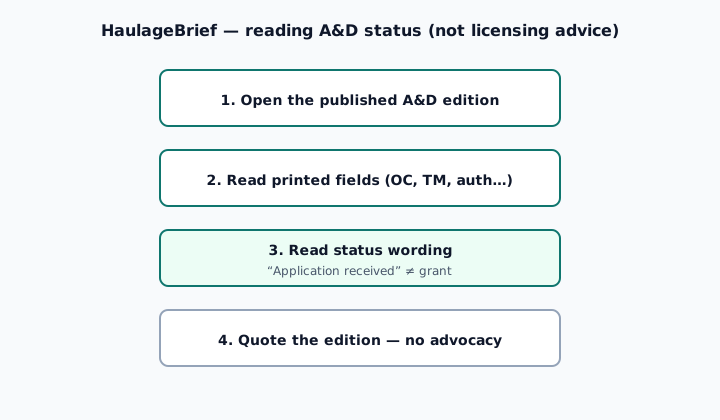
When you open an A&D PDF, read the section heading first. It changes the meaning of every line underneath:
- “New applications” → application received, not a grant. See reading A&D status words.
- “Variations” → change sought to an existing licence.
- “Decisions” → outcome as the Traffic Commissioner published it.
- Disciplinary sections → curtailment, suspension, or revocation wording — the 21-day objection clock usually does not apply. See 21-day objection clock for contrast.
For the full field map — licence type, operating centre, authorisation, transport manager, status, objection deadline — see how to read an A&D entry.
Worked example · one live sample
East of England AD 5603 — GBRS HAULAGE LIMITED, OF2093787
SN (Standard National) application — not a grant. Operating centre at Sunderland Hill, Ravensden. Authorisation sought: 16 vehicles and 20 trailers. Transport manager named as Stephen Page. Status: application received.
What HaulageBrief does (and does not do)
You paste the public GOV.UK URL of a named A&D edition (or a named public-inquiry written decision) and name the operator if the PDF lists several. We send a £79 PDF in 24 hours that states the operator, licence or application number, licence type as printed, operating centre(s), authorisation, transport manager (if named), status, and objection deadline (if the edition prints one). We cite the published wording. If the publication is thin, the PDF says so.
What it is not
- Not licensing advice. We do not tell you whether you need an O-licence, which type to seek, or how to run the fleet.
- Not O-licence application writing. We do not prepare, lodge, or chase an application, variation, or newspaper notice.
- Not public-inquiry advocacy. We do not represent anyone before a Traffic Commissioner or prepare a case.
- Not TM CPC training, and not a substitute for reading the publication or instructing a transport consultant or solicitor.
See the East of England sample Order a £79 sourced reading
Questions
What is a goods vehicle operator’s licence?
A goods vehicle operator’s licence (O-licence) is the licence issued by a Traffic Commissioner that authorises an operator to use goods vehicles above specified weight limits for trade or hire or reward in Great Britain. This guide explains how published documents describe licence activity — not how to apply. See GOV.UK — Being a goods vehicle operator for official guidance.
Where are O-licence applications and decisions published?
Traffic Commissioners publish weekly Applications and Decisions (A&D) statements for each traffic area on GOV.UK. These list applications received, variations, decisions, and related notices. Collection home: Traffic Commissioner Goods Vehicle Applications and Decisions.
Does an A&D entry mean the licence is granted?
Not necessarily. Many entries are applications received or variations sought. Grants, refusals, and inquiry outcomes appear under other headings with outcome wording. Always read the section heading and status line. See reading A&D status words.
Will you write the O-licence application or represent us at a public inquiry?
No. We do not prepare, lodge, or chase an application or variation, and we do not advocate, appear, or prepare a case. A HaulageBrief PDF is a reading of what was published, not representation.
Is this licensing advice?
No. This guide and the £79 PDF are sourced readings of public Traffic Commissioner publications. The Office of the Traffic Commissioner’s document remains the legal record. If you need advice, instruct a transport consultant or solicitor.
Who runs HaulageBrief?
Ellis Greensitt, sole trader, trading as HaulageBrief. English law. See terms and privacy. Email hello@haulagebrief.co.uk. No telephone.
Sources cited on this page: GOV.UK — Being a goods vehicle operator; GOV.UK — Traffic Commissioner Goods Vehicle Applications and Decisions; HaulageBrief sample for East of England AD 5603, GBRS HAULAGE LIMITED OF2093787 (published 2 September 2026). Public sector information reused under the Open Government Licence v3.0. Last reviewed 16 September 2026. HaulageBrief is not the Office of the Traffic Commissioner and is not GOV.UK.