United Kingdom · Traffic Commissioner A&D · reading only · 22 September 2026
Standard International vs Standard National authorisation wording on A&D — reading only
How to read Standard International and Standard National authorisation wording when both appear on published Traffic Commissioner Applications & Decisions entries — and how to keep licence-type labels, vehicle/trailer figures, and status words separate. Literacy only; not advice on which authorisation to seek.
Weekly Applications & Decisions editions list goods-vehicle operator-licence applications, variations, and decisions under headings such as new applications or variations. Most entries print a licence type — often as a code (SN, SI) or spelled out (Standard National, Standard International) — alongside vehicle and trailer authorisation figures. The full field map sits in how to read an A&D entry. This page is narrower: reading what SN and SI authorisation wording means on the printed page, without upgrading an application line into a grant or treating the type label as advice on what your operation should hold.
Where SN and SI authorisation wording sits
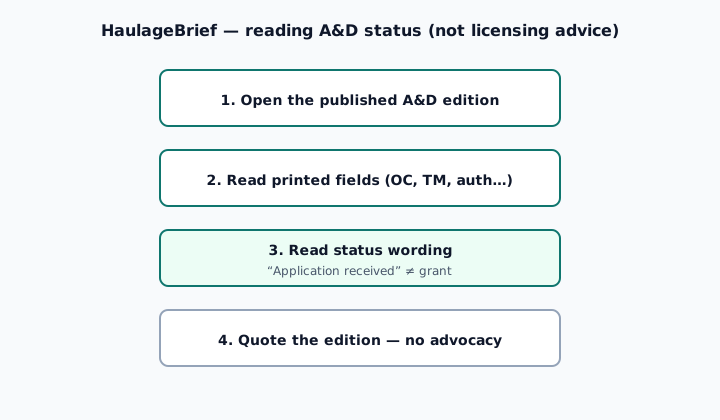
Goods-vehicle A&D is collected on GOV.UK under Traffic Commissioner Goods Vehicle Applications and Decisions. House style varies by traffic area, but a typical new-application line prints:
- Licence type — SN / Standard National, or SI / Standard International, as that edition codes or spells it.
- Application or licence reference — for example OF2093787 on an application line.
- Operating centre — place/address wording (not the same field as authorisation figures).
- Authorisation sought or recorded — vehicle and trailer numbers, often labelled “Authorisation sought:” on applications lines.
- Status — for example “application received” on a new application; see reading A&D status words.
The SN or SI label describes which kind of standard licence the line concerns as printed. It does not, by itself, tell you whether international carriage is already authorised, refused, or only sought. Read the section heading and status wording together — the same discipline as SN, SI, Restricted licence-type codes.
Standard National wording as printed
On many editions, Standard National or SN appears next to the operator name and application reference, followed by vehicle and trailer counts under Authorisation sought: on new applications lines. Cite the type exactly as printed; cite authorisation figures as numbers, not places — see authorisation vs operating centre on A&D. Do not treat “Standard National” plus “application received” as proof of grant, and do not infer from SN wording alone whether international haulage is excluded — that sits outside a sourced reading of one line.
Standard International wording as printed
Standard International or SI lines use the same layout as SN lines on most weekly editions: operating centre, authorisation figures, transport manager (when named), and status. The difference is the licence-type label — not necessarily a separate “international authorisation” sub-block on every template.
Some entries add international or community-licence-related phrases where the print layout includes them. Quote such wording verbatim. If the PDF is silent beyond the SI label, record that silence rather than importing language from guidance or another entry. On variation lines, quote whether the edition describes a type change, an authorisation increase, or both — do not paraphrase into “upgrade” language unless the entry uses it.
SN vs SI on the same edition — side-by-side reading
A single A&D issue may list both SN and SI applications under new applications. Compare entries by field, not by assumption:
-
Read the section heading — new applications, variations, decisions, or curtailment/revocation blocks use different force. See curtailment, revocation and suspension wording for non-application sections.
-
Note the licence-type label — SN/Standard National vs SI/Standard International as printed for each operator line.
-
Copy authorisation figures separately — vehicle and trailer counts are not interchangeable between operators or between centres on multi-centre lines.
-
Check status and objection invite — if “representations may be made” appears, the 21-day objection clock may apply from the A&D publication date.
-
Stay in the reading lane — no advice on whether to seek SN or SI; no O-licence application drafting.
Worked contrast · SN line on a live sample
East of England AD 5603 — GBRS HAULAGE LIMITED, OF2093787
This sample is an SN (Standard National) application line — not SI. Authorisation sought: 16 vehicles and 20 trailers at one operating centre. Status: application received. Use it to practise separating type label, centre, figures, and status. An SI line on another edition would follow the same reading steps with SI/Standard International as the type label.
Variations and decisions — when SN/SI wording changes force
Under variations, an entry may seek a change from Standard National to Standard International, or additional authorisation at the same type. Under decisions, outcomes may restate type and authorisation as granted or refused. Quote the decision line; do not back-fill from an earlier applications edition unless comparing two published documents. For interim grants, see interim wording on paper.
See the East of England sample Order a £79 sourced reading
Questions
Does Standard International wording on A&D mean international haulage is authorised?
On an applications line, SI or Standard International describes the licence type sought as printed — not a grant. Read section heading and status. HaulageBrief cites the printed type and figures; we do not advise whether your operation needs international authorisation.
How is SI authorisation wording different from SN on the page?
On most weekly editions the layout is the same: type label, centre, vehicle/trailer figures, status. The difference is the SN vs SI label (and any extra international/community phrases that edition prints). This guide explains how to read those labels — not which type to apply for.
Will HaulageBrief advise whether to seek Standard International?
No. We cite licence-type and authorisation wording as printed. We do not prepare or lodge O-licence applications or variations.
Is this licensing advice?
No. This guide and the £79 PDF are sourced readings of public Traffic Commissioner publications. If you need advice, instruct a transport consultant or solicitor.
Who runs HaulageBrief?
Ellis Greensitt, sole trader, trading as HaulageBrief. English law. See terms and privacy. Email hello@haulagebrief.co.uk. No telephone.
Informational reading guide only. Sources: GOV.UK — Traffic Commissioner Goods Vehicle Applications and Decisions; HaulageBrief sample for East of England AD 5603, GBRS HAULAGE LIMITED OF2093787 (SN application as published). Public sector information reused under the Open Government Licence v3.0. Last reviewed 22 September 2026. HaulageBrief is not the Office of the Traffic Commissioner and is not GOV.UK.